
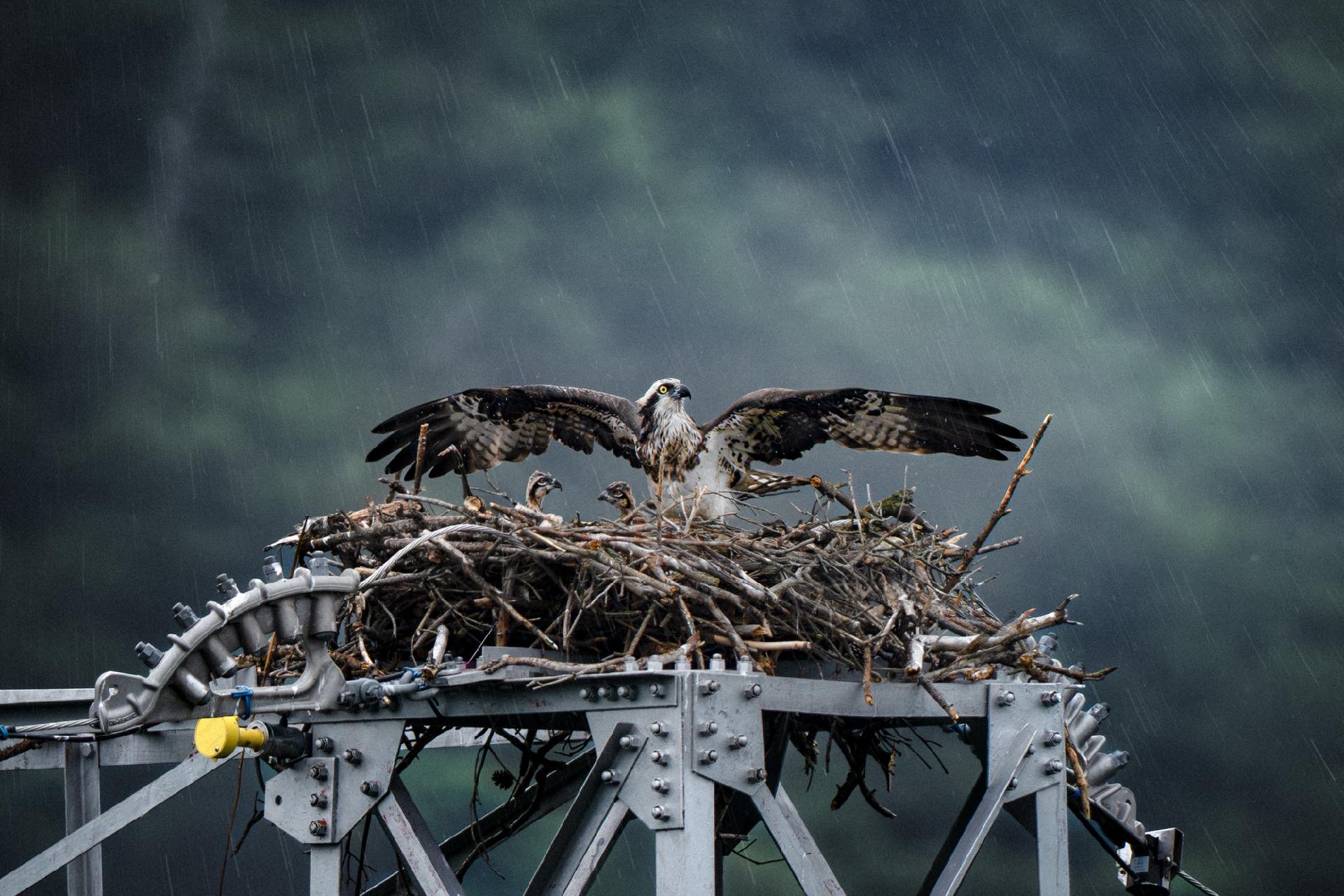
The Iron Sanctuary
The Iron Sanctuary
Behind the Photograph
As I stack years of experience as a photographer, I find myself deeply questioning the fundamental purpose: "Why do I take photographs?" Through countless shoots, I feel my thoughts on what to capture, or where to point my lens, becoming sharper and more refined. Amid this, for the past three years, I have been pursuing the nesting of a wild bird, the osprey, with a special sense of purpose.
Originally, they built their nests on the mountainside far from human reach. However, as soon as construction work began on that mountain, the ospreys lost their home and disappeared. Human development robbed them of their peaceful sanctuary.
Yet the following year, they built a new nest at the top of a transmission tower nearby. Driven away by humans, these creatures ironically found their "sanctuary" atop a human-made structure, beginning to raise new lives. I became strongly drawn to this resilience of wildlife.
Respect for the Ecosystem
The osprey is designated as a near-threatened species in Japan, and photographing their nesting should naturally be done with extreme care from a conservation standpoint. Posting images on SNS that might identify the location is strictly regulated. Therefore, in cooperation with the Wild Bird Society of Japan and Kyoto University of the Arts, I continue this project as an academic ecological study, paying maximum respect to the ecosystem.
I Simply Watch Over
Ospreys are highly cautious birds, crying out in alarm if they detect a human presence. The shooting location is about 150 meters from the nest, and because I look through the thicket, they do not notice my presence. Keeping a distance to ensure their "sanctuary" is not threatened, there is nothing I can do but simply watch over them.
The harsh sun relentlessly beating down on extreme summer days, storms from direct typhoons, and attacks by predators—the place they have chosen is unforgiving.
I want to hold an umbrella over them. I want to support the nest so it won't blow away. I want to chase away their predators. Yet, I can do nothing but watch over them.
Driven away by humans, yet choosing to coexist with them—what is it that we can do for them?
As global warming progresses and extreme heat and typhoons increase, this place may eventually cease to be a safe haven (sanctuary) for them.
What is it that I can do? I continue to confront this question: "Why do I take photographs?"
Learning from Them
When the chicks were still small, a worryingly heavy rain began to fall. Suddenly, the mother bird spread her wings to shelter her young from getting wet. Such behavior in ospreys is not widely known, and I could only catch my breath at the reality unfolding before my eyes.
An unconditional love from parent to child. It is a universal truth that transcends species, and it is a sanctuary of its own.
Two Overlapping Generations
For this shoot, I always head into the mountains with my father, who is now over 80 years old. As we both age, I do not know how many more years we will be able to hike these mountains and share this time. I realize that this osprey shoot is simply a "pretext" to spend precious time together with my father.
As I watch the osprey family on the transmission tower, desperately protecting and raising their young, I quietly overlap our own relationship with theirs. I feel that the two generations' time silently intersects.
Another Source Beyond the Frame
Although I head into the mountains to photograph the ospreys, in my heart, as a sort of paradox, I feel that the photographs themselves are secondary. Our true purpose is simply to visit the osprey family, to quietly watch over their devotion to raising their chicks, and at the same time, to share that silent space together as father and son.
What I always think about through this project is: "To put what is not captured in the photo, into the photo."
My father does not appear in the final photograph. Yet, the time spent side by side, holding our breath, and the quiet, wordless feelings we shared certainly existed there. How this invisible time and emotion manifest as warmth or depth behind the work is a question I ask myself.
To the question, "Why do you take photographs?" my other answer lies on a completely different axis from the photograph as a result—it dwells within the accumulation of invisible time, in a realm beyond words.