
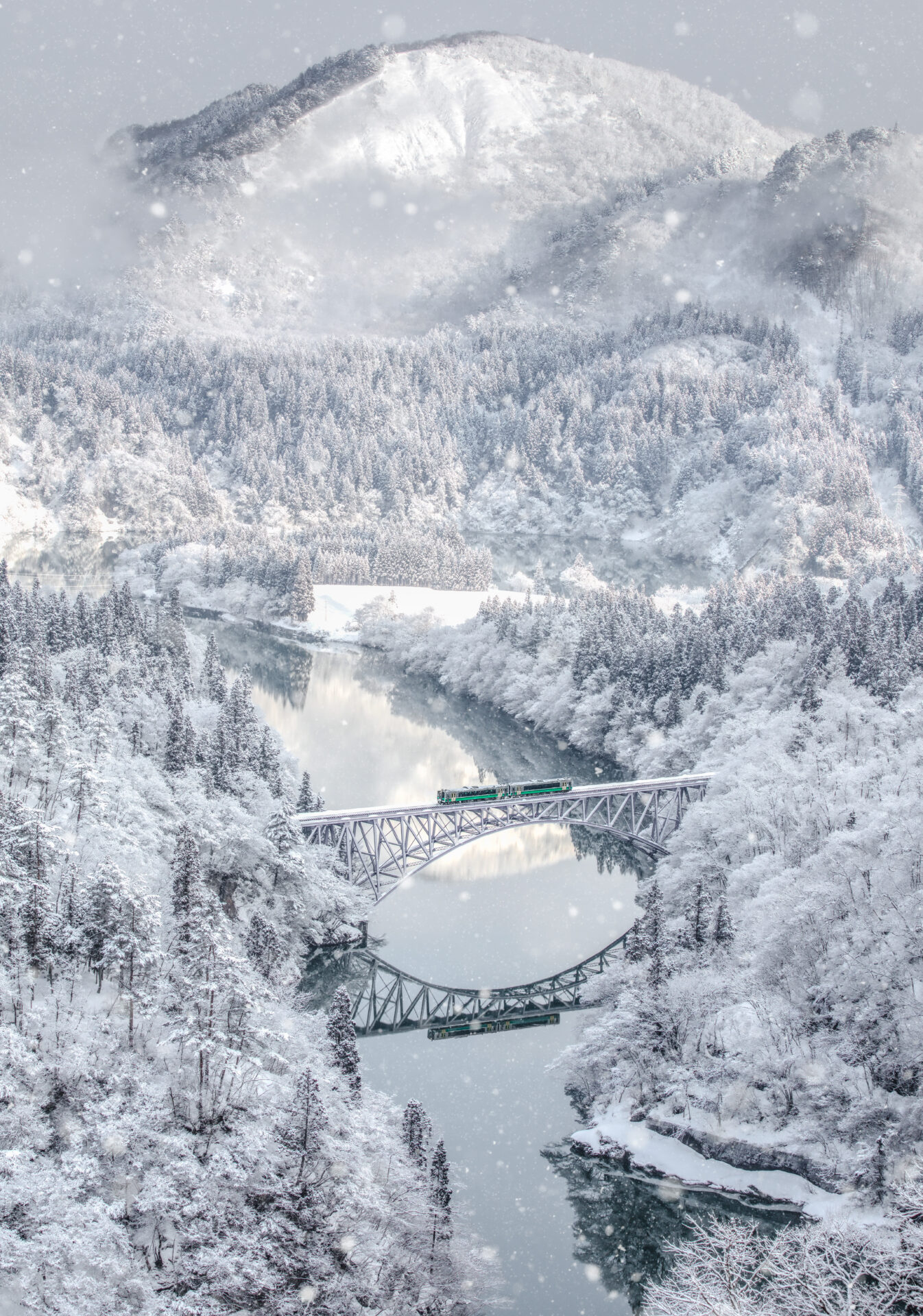
Coexistence of Man and Nature
Tadami Line in Winter — IPA 2022 Nature Photographer of the Year
Behind the Beautiful Landscape
The winter scenery of the Tadami Line, which runs through Mishima Town in Fukushima Prefecture, is a dream destination not only for railway enthusiasts but also for many photographers. However, most people who visit this spot frame only the train and the beautiful arched bridge, isolating them in a tight frame.
Initially, I visited simply because it was a beautiful place. But when I stood there, my gaze was drawn not to the train or the bridge, but to the rugged, silent mountain towering behind them.
Checking the map, I found it was named Mt. Hyugakura. "Hyuga" means a warm, sunny place, while "Kura" refers to a rugged cliff or rocky area in mountain terminology. Intrigued by this name with two contrasting meanings, I began to research the Tadami Line and the region in depth.
Harsh Floods and Living with Nature
The Tadami Line suffered devastating flood damage in the 2011 Niigata-Fukushima heavy rains. With bridges washed away, parts of the line were suspended for 11 long years. With a declining population and operating deficits, permanent closure of the line was repeatedly discussed.
While this land is breathtakingly beautiful, it also possesses the harshness of a fierce nature. Despite this, the local residents live without excessive development, respecting the majestic environment and coexisting in harmony.
At that moment, my interpretation of this place transformed. "This is not just a beautiful landscape. It is a place that embodies the coexistence of man and nature, leaning on each other."
That is why I had to include Mt. Hyugakura, the symbol of nature's harshness, in the composition. Placing the train small within the vast nature highlights both the overwhelming scale of the environment and the humble yet resilient lives of the people. I was convinced of this.
Three Years in Pursuit of the Perfect Moment
To capture this vision in a single photograph, I spent three years traveling back and forth. I was waiting for the perfect overlap of three conditions:
- The entire landscape covered in pure white snow
- The water surface of the Tadami River windless and reflecting the opposite bank like a mirror
- Snow flurries gently falling to give emotional depth to the frame
With global warming in recent years, days when all these conditions align are very rare—sometimes not even once a year.
There were days with no snow at all, and days when the snow fell so heavily that the train was canceled. Some days a blizzard blocked all visibility, and I returned with nothing—in fact, I went home empty-handed most of the time. Since wind ruins the mirror-like surface of the river, it was always a battle of timing right after dawn when the wind was still.
When the moment finally came, I used a flash to freeze the flurries of snow and clicked the shutter. Looking through the viewfinder, the feeling that welled up in my heart was not "I took it" but a deep sense of gratitude: "I was allowed to take this photo by nature."
Photographs have power. The power to make people think and act. Sometimes photographs convey painful realities—war, conflict, struggle. However, humans can learn from them, think, and act to avoid them. That is why I chose photographs that make people think and act.
Your photograph is extremely beautiful, but at the same time, it carries the severity of nature. It truly tells the story of the coexistence of man and nature. From this image, I felt a quiet plea: 'I want to protect this nature.' People who see this will want to protect this view, and they will take action.
Not Just to Document Beauty, but to Preserve the Reality for the Future
Hearing these words from the judge, I couldn't help but shed tears. I realized that my feelings, without any explanation, had reached someone across the ocean through a single photograph.
This experience shaped my stance as a photographer. To take photos that make people think and act—this is my driving force today.
With global warming and depopulation, these beautiful landscapes and traditional cultures are disappearing. Rather than just archiving them as records of the past, I want to use the power of photography to help preserve the actual scenery for the future.
So that my children, and the generations after them, can see this same beautiful scenery of the Tadami Line with their own eyes.
I hope that the warm desire of viewers to protect this scenery will lead to concrete actions for environmental protection and regional revitalization. I will continue to pursue photographs that create such a chain of action.